
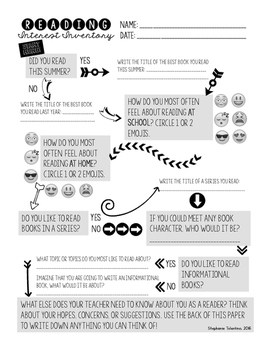
Literacy Interest Inventory A literacy interest survey helps educators to gain an understanding of student interests, which may include information on their likes, dislikes, favorite things, or hobbies. I have offered my readers an interest inventory before, but it was kindergarten specific and in color. I get that many of us are ‘color printer challenged.’ So, I decided to go ahead and make a general, non-grade specific, one in black and white. Taking time to do Interest Inventories is an investment that will pay dividends later, especially for the struggling readers who might not think they would enjoy reading anything. With the right topic choice based on interest, you might hook every kid onto reading this year! The two assessments for Literacy Interest Survey came from Heinemann. It is a website designed for literacy training. It is for teachers who are focusing on tutoring students in writing. The website has materials for grades K-12, and breaks down different strategies for literacy.
Server crasher cs 1.6multiprogramem. As I learned by experience in 8th grade, career interest assessments have their limitations. They have their benefits, too.
Today we’ll look at a few career interest assessments that can help kids with very limited reading or language skills begin to choose their own career exploration paths.
Literacy Interest Inventory Pdf
Some Limitations of Career Interest Assessments
- They don’t consider how a person’s skills relate to the essential tasks of a job.
- They must be combined with thorough job analysis and skill assessment.
- Career interests identified through assessment should be verified through actual experience in work environments.
Benefits of Career Interest Assessments
- They help kids consider what they prefer and value.
- Results may suggest options kids would never otherwise consider.
- They can point to work environments and job tasks that can be further investigated through job shadowing and community-based work assessment.
Context
Preference Matters
In the past, people with significant disabilities were placed in jobs that were available, without considering the individual’s preferences. All people are more satisfied and more successful in jobs that match both their skills and their preferences. And IDEA requires that a student’s preferences be considered in planning post-high school goals.
Career interests may change over time as a person gains actual experience in various work environments. Remember my candy-striper story? Career planning is an ongoing process, not a “one-shot deal”.
More Than One Way
Donald Super (1990) names three types of interest: expressed interest, manifested interest and tested interest. Listen to your child’s expressed interests. Observe the environments and tasks he prefers. Never rely solely on the results of a career interest assessment to identify potential career options.
Consider Pre-Requisite Skills
An assessment is a good match for a student when he has the skills needed to understand and respond to the assessment tasks. The method used to respond can often be adapted without affecting assessment results. But consider the student’s skills in relation to an assessment before moving forward.
Reading
Reading is a foundational skill that increases a person’s quality of life in all areas. Research-based instructional programs are now available to teach reading decoding skills to people with significant disabilities. These programs should be seriously considered. When implemented, they should be used with fidelity.
Though it’s possible to modify work environments and tasks for people who do not read, we should do our best to teach reading to all students using research-based instructional programs.
Reading Free Vocational Interest Inventory (RFVII -2)
This assessment is designed for people with disabilities ages 13-adult. Its reliability has been demonstrated by many studies and it has been normed by age, gender and disability type. It uses simple black and white line drawings that direct attention to the job task being pictured without extraneous variables such as color.
A series of 55 sets of three drawings each, depicting different job tasks, is presented. The student chooses one preferred job task in each set of three.
The assessment yields data about preferred career clusters, work environments and job tasks. This information can guide next-step planning for job shadowing and community-based work assessment.
Pre-requisite skills: The student must be able to choose from three options represented by pictures and be able to interpret the pictures as representing a job task.
Accommodations: The assessment can be administered over several sessions (for students with attention limitations) and the method of response can be adapted. For example, for a student who will respond by eye-gaze, the pictures can be cut out and positioned as needed.
To find out more about RFVII-2, click here.
Other Considerations There are other picture-based career interest assessments available, including Cops-Pic and Picture Interest Career Survey. Before choosing any assessment, consider the research supporting it. Also be sure it aligns with your child’s skill level.
Choose and Take Action
Choose and Take Action is an interactive software program that is meant to be used on an ongoing basis as a student tries out various job choices.
Literacy Interest Inventory
The program uses simple line drawings to teach students job characteristics. The student views short job videos to identify the job characteristics of each and to select preferred jobs .
Visual aids are provided to support job shadowing experiences and to guide self-evaluation during community-based work assessment. The program uses a repeated measures situational assessment process to assess vocational interests. Reports can be generated to document all the student’s choices over multiple experiences.
You can learn more about Choose and Take Action, including pre-requisite skills, methodology and the still-emerging research base for the program from this Self Determined Employment Powerpoint by Dr. James Martin of the Zarrow Center at the University of Oklahoma.
Choose and Take Action can be ordered here.
You may also be interested in Self Directed Employment, a handbook for teachers and employment staff that explains how to use visual supports to actively engage students in job shadowing, community-based work assessment and supported employment.
Your Employment Selections (YES)
This internet-based job preference program uses videos of 120 jobs. The videos are presented in pairs, with narration describing key tasks. Participants choose one preferred job or neither from each pair.
Reports can be generated listing particular work environments, work tasks and job titles of interest to the participant. These jobs can then be investigated further through actual experiences in work environments.
To learn more about the YES program, click here. A bibliography of related research can be found here: YES Research Bibliography.
Final Notes
I do not benefit in any way from reviewing the products featured in this post. My intent is to introduce you to an array of effective reading-free career interest assessments. However, I can’t recommend a specific assessment for a student without knowing his or her particular needs. Collaborate with other members of the IEP team to choose effective ways for your child to assess career interests.
May your child enjoy exploring potential careers! It should be a positive and exciting process.
Has your child used any of the assessments listed here? Or others? Please share your insights and experiences in the comments below.
Photo credit: Rosmary at Flickr